

Cash on Delivery, or COD, is one of the biggest reasons ecommerce works in Bangladesh.
It gives customers a simple way to order products without paying online first. For many shoppers, especially first-time buyers, paying after receiving the parcel feels safer.
But COD creates another problem for ecommerce sellers.
A customer can place an order without paying anything upfront. The seller then spends money to pack the product and send it through a courier. If the customer refuses the parcel, cannot be reached, gives an incorrect address or simply changes their mind, the product comes back.
The seller loses money even though no sale was completed.
For COD-heavy ecommerce businesses, this can become a serious problem. Recent Bangladesh-focused ecommerce sources report COD return rates of around 20%–30% for some stores without proper verification, while other businesses and product categories can experience even higher rates. These figures should be treated as market observations rather than an official nationwide average.
And the cost is not limited to one delivery charge.
There can be:
Forward delivery cost
Return delivery cost
Packaging cost
Staff processing time
Lost selling opportunity
Inventory being unavailable during transit
Customer-support costs
For planning purposes, many merchants use roughly ৳120–৳150 per failed parcel as a working estimate for courier-related loss, although the actual amount depends on courier rates, delivery zone, parcel size and merchant terms. Some published Bangladesh examples show the total forward-and-return cost can be even higher.
So how can an ecommerce business reduce fake COD orders without making genuine customers uncomfortable?
The answer is not to remove COD.
It is to make COD smarter.
What Is a Fake COD Order?
A fake COD order is an order where the customer provides details and asks the seller to ship the product but does not have a genuine intention to complete the purchase.

Not every failed COD delivery is fraud.
A customer may refuse a parcel because:
They changed their mind.
They ordered the wrong product.
The product arrived later than expected.
They entered the wrong address.
They could not receive the parcel.
They no longer had the money available.
Someone else in the household placed the order without permission.
There are also deliberate fake orders.
For example, someone may use a real person's phone number and address to place an order as a prank. A competitor or malicious user may repeatedly place orders that are never collected.
The seller usually cannot know the customer's intention when the order arrives.
That is why risk detection is more useful than simply calling every order "fraud."
Why Do So Many COD Parcels Get Returned in Bangladesh?
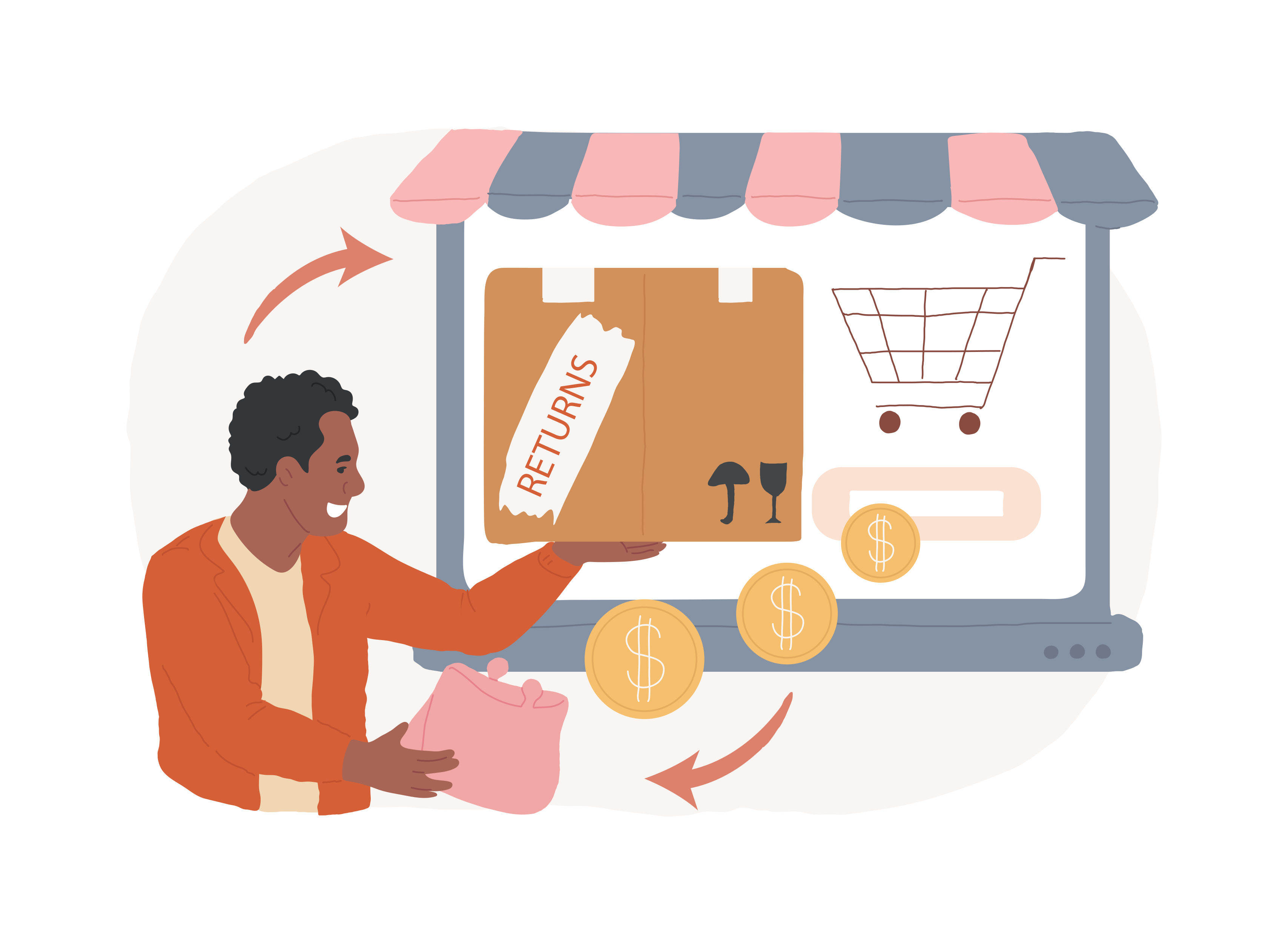
The problem comes from the way COD changes the customer's commitment.
With prepaid ecommerce, the customer has already transferred money.
With COD, the customer has made a purchase decision without making a financial commitment.
That creates a gap between:
Order placed → Order actually wanted
A customer may feel confident enough to click "Place Order" but change their mind before the courier arrives.
There are several other reasons.
1. Impulse Ordering
Social media advertising makes it very easy to place an order.
A customer sees a product, likes it and places a COD order.
Later, they decide they do not really need it.
2. Multiple Orders
Some shoppers order the same or similar product from several stores.
When the courier arrives, they accept only one parcel.
3. Incorrect Phone Numbers
A customer may accidentally enter the wrong number.
A fake customer may deliberately provide an invalid number.
Either way, the courier cannot reach them.
4. Incorrect Addresses
Bangladesh addresses can be difficult to standardize.
A customer may provide a nearby landmark instead of a complete address, or enter information incorrectly.
The courier may be unable to complete the delivery.
5. Customers Refuse the Parcel
Sometimes the customer simply tells the courier:
"I don't want it anymore."
At this point, the seller has already paid part of the cost of getting the product to the customer.
6. Fake or Malicious Orders
Some orders are placed with no intention of receiving the product.
These are the orders that ecommerce businesses should try to identify before dispatch.
The Real Cost of One Fake COD Order

Consider a simple example.
Suppose a store receives 100 COD orders.
If 25% fail to reach the customer, that means:
25 returned parcels
If the merchant loses an estimated ৳120–৳150 per failed parcel in courier-related costs, the direct delivery loss becomes approximately:
25 × ৳120 = ৳3,000
to
25 × ৳150 = ৳3,750
And this is only the courier-related estimate.
The actual business impact can be higher because the merchant may also lose:
Packaging material
Staff time
Marketing spend
Product handling cost
Inventory availability
Potential profit from a genuine order
Some published Bangladesh examples calculate the total forward-and-return shipping cost at around ৳195 for a failed parcel, demonstrating that actual losses can exceed the lower planning range depending on courier and shipment conditions.
Now imagine the store processes 1,000 COD orders every month.
A 20% return rate means:
200 returned parcels
At ৳120–৳150 each, that represents approximately:
৳24,000–৳30,000
in courier-related losses.
At a 30% return rate:
300 returned parcels
The estimated courier-related loss becomes:
৳36,000–৳45,000
That is money the business could otherwise use for inventory, marketing or growth.
7 Effective Ways to Prevent Fake COD Orders
The best approach is not one security feature.
It is a combination of several small checks.
1. Use AI Fraud Scoring Before Shipping
One of the most useful approaches for a growing ecommerce business is risk scoring.
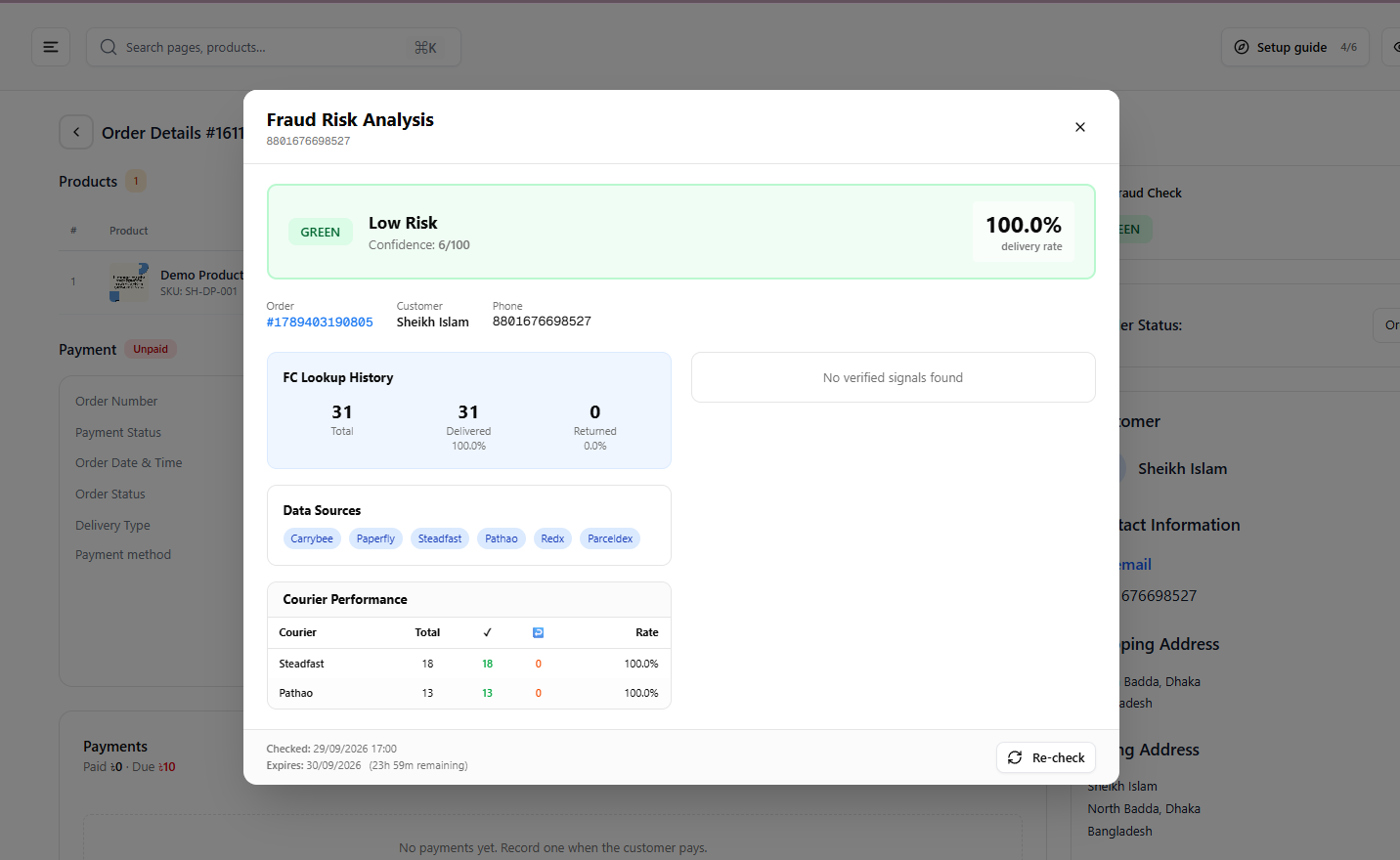
Instead of treating every COD order equally, a fraud detection system examines different signals and assigns the order a risk level.
For example:
Low risk
A returning customer with:
Previous successful deliveries
Verified phone number
Normal order value
Consistent address
Low return history
This order can usually move through the normal fulfilment process.
Medium risk
A new customer with:
No previous order history
A higher-than-usual order value
Unusual delivery information
The business may choose to verify the order before dispatch.
High risk
An order associated with:
Repeated failed deliveries
A phone number with a poor order history
Unusual ordering behavior
Multiple suspicious orders
Other high-risk signals
The business can hold the order for review.
Modern ecommerce fraud systems use signals such as order history, customer information, IP or device information, order velocity and other behavioral indicators to score risk. WooCommerce fraud-prevention tools increasingly use this layered approach rather than relying on a single rule.
The important point is:
AI should help prioritize suspicious orders. It should not blindly reject every unusual customer.
A good system gives the merchant another layer of information before shipping.
2. Block Phone Numbers With Repeated Failed Deliveries
Your customer database contains valuable information.
Suppose a phone number has placed:
8 COD orders
6 failed deliveries
5 refused parcels
That number deserves more attention than a customer with a history of successful purchases.
This is why ecommerce businesses should maintain a return-history database.
When an order is returned, the system can record the customer's phone number and delivery history.
If the same number repeatedly creates failed orders, the business can:
Require verification
Disable COD
Ask for an advance delivery payment
Send the order for manual review
Block future orders if appropriate
Phone numbers should not automatically be treated as proof of fraud, because numbers can be shared or entered incorrectly.
But repeated behavior is a useful risk signal.
3. Use OTP Phone Verification
One of the simplest ways to improve COD order quality is phone verification.

The process is straightforward.
Step 1
Customer enters their phone number.
Step 2
The store sends a one-time password, or OTP.
Step 3
Customer enters the OTP.
Step 4
The store confirms that the customer has access to that phone number.
This does not prove that the customer will accept the parcel.
But it removes one common problem:
fake or invalid phone numbers.
OTP verification can be especially useful for:
New customers
High-value COD orders
Customers with suspicious order patterns
Orders from channels with higher fake-order risk
BitCommerz includes an SMS gateway that can be used for order updates and OTP-related customer communication.
4. Add a Small Advance Delivery Charge
You do not always need to ask customers to pay the full product price upfront.
A small advance delivery charge can create a useful middle ground.
For example:
Product price: ৳1,000
Delivery charge: ৳100
The customer pays the delivery charge in advance and pays the remaining product amount when the parcel arrives.
Why can this help?
A person who is not serious about receiving the product may be less willing to make even a small advance payment.
At the same time, genuine COD customers can still use the payment method they prefer.
This approach can be particularly useful for:
High-return products
Expensive products
New customers
Areas with unusually high return rates
COD fees or partial advance payments are also commonly recommended as a way to reduce the cost of failed COD orders and encourage prepaid payments.
However, the charge should be clearly shown before checkout.
Surprising customers with an unexpected fee can create another conversion problem.
5. Give COD Customers a Reason to Pay Online
The goal should not always be to eliminate COD.
Instead, give customers a reason to choose prepaid payment.
For example:
COD: ৳100 delivery
bKash payment: Free delivery
Or:
COD: Standard delivery
Prepaid: ৳50 discount
The exact offer depends on your margins.
The idea is simple:
Reduce the seller's risk while giving the customer a benefit.
Bangladesh customers may prefer COD because it feels safer. Giving them a small financial benefit can gradually move some genuine customers toward prepaid orders.
6. Verify High-Risk Orders Before Dispatch
You do not necessarily need to call every customer.
That can waste staff time.
Instead, verify orders that have risk signals.
For example:
First-time customer
High-value order
Multiple quantities
Suspicious phone history
Previous returned orders
Unclear address
Unusually high order frequency
A simple confirmation call can ask:
"Hello, you recently placed a COD order with us for [product]. We are preparing the parcel. Can you please confirm that you still want the order delivered to this address?"
You are not interrogating the customer.
You are confirming purchase intent.
Recent Bangladesh-focused guidance similarly recommends focusing confirmation efforts on orders carrying risk signals rather than manually calling every COD customer.
7. Track Return Rates by Phone, Product and Area
Your return data can tell you where the problem is.
Do not track only:
Total returned orders
Track:
Return rate by phone number
Return rate by customer
Return rate by product
Return rate by location
Return rate by courier
Return rate by marketing source
Return rate by order value
For example, imagine this data:
Product | Orders | Returned | Return Rate |
|---|---|---|---|
Product A | 500 | 50 | 10% |
Product B | 500 | 150 | 30% |
Product C | 500 | 200 | 40% |
Product C deserves investigation.
Maybe:
The product description is misleading.
The product quality does not match expectations.
The price creates impulse orders.
Customers misunderstand its size.
The advertising is attracting the wrong audience.
This is important because not every return is a fraud problem.
Sometimes your product page or marketing is creating the problem.
Fake Order Prevention Should Not Hurt Genuine Customers
There is a major mistake businesses can make when fighting fake orders.
They can become too aggressive.
For example, if you block:
Every new customer
Every unusual address
Every high-value order
Every customer without previous purchase history
you may reduce fake orders.
But you may also reject genuine customers.
A better approach is risk-based verification.
Low-risk order
Ship normally.
Medium-risk order
Request OTP or confirmation.
High-risk order
Ask for partial advance payment or conduct manual verification.
Repeated high-risk behavior
Restrict COD or block the customer according to your business rules.
This layered model is also consistent with modern ecommerce fraud-prevention practices, where suspicious orders are flagged, held or blocked based on multiple signals rather than one simple rule.
Why Manual Fake-Order Checking Stops Working
Manual verification may work when a store receives 10 orders per day.
But imagine receiving:
300 COD orders every day.
Your staff cannot realistically:
Check every phone number
Search every customer history
Call every buyer
Compare every address
Check every previous return
Update every blacklist manually
This is where automation becomes important.
The goal is not to remove people from the process.
It is to let technology identify which orders deserve human attention.
How BitCommerz Helps Reduce COD Fraud and Return Losses
BitCommerz has built COD protection directly into its ecommerce platform.
Its AI Fraud Scoring checks COD orders and assigns a risk score before the order is shipped. BitCommerz says its system uses more than 100,000 data points to evaluate COD orders and can automatically hold high-risk orders before dispatch.
That changes the workflow from:
Order → Ship → Return → Discover the problem
to:
Order → Risk check → Verify or hold → Ship
That difference can save a significant amount of wasted courier expense.
AI Fraud Scoring
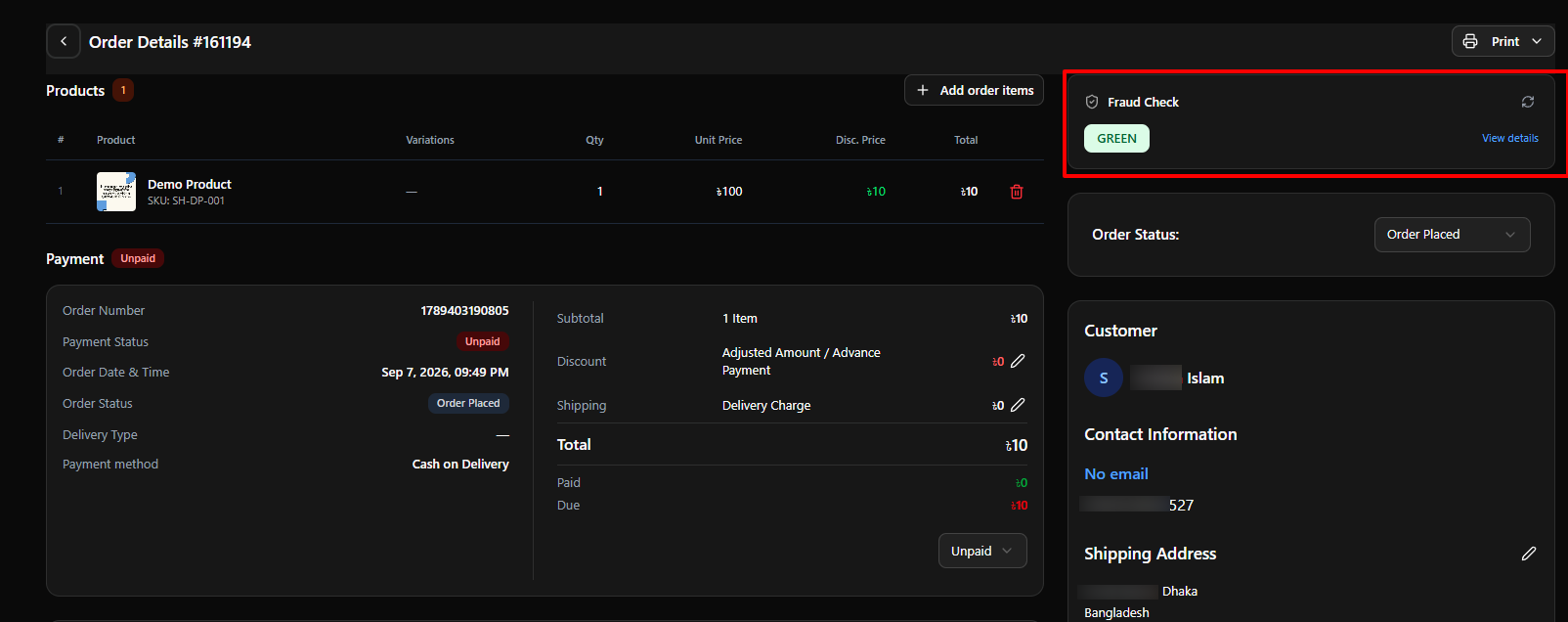
Each COD order can be evaluated before shipment.
High-risk orders can be held instead of automatically entering fulfilment.
This gives the merchant an opportunity to verify the customer before spending money on delivery.
COD and Multiple Payment Options
BitCommerz supports COD alongside payment methods such as bKash, Nagad and cards, plus Rocket through SSLCommerz or aamarPay.
This allows a merchant to keep COD available while also giving customers alternatives.
That is important in Bangladesh because removing COD completely can also mean losing genuine customers who prefer to pay after receiving their products.
OTP and SMS Communication
BitCommerz provides an SMS gateway for customer communication, including OTP and order-related messages.
This can support a verification workflow where merchants want additional confirmation before fulfilling selected orders.
Courier Integration
After an order passes the merchant's checks, it still needs to reach the customer.
BitCommerz integrates courier workflows including Pathao, Steadfast, RedX and CarryBee, with parcel booking and tracking from the platform.
This reduces the need to manually copy customer details from one system into another.
Order History and Customer Data
Fraud prevention becomes much more useful when the business can see customer and order history.
BitCommerz provides order management and customer data tools that help merchants keep their ecommerce operations organized.
This creates the foundation for identifying patterns such as repeated failed orders.
A Better COD Workflow for a Bangladesh Ecommerce Store
A practical workflow can look like this:
Step 1: Customer places the order
The customer chooses COD at checkout.
Step 2: The order receives a risk assessment
The system checks available customer and order signals.
Step 3: Low-risk orders continue
The store prepares the parcel normally.
Step 4: Medium-risk orders receive verification
The store can request OTP or customer confirmation.
Step 5: High-risk orders are held
The seller can review the order before shipping.
Step 6: Repeat-return customers receive additional restrictions
The seller can require advance payment or disable COD according to their policy.
Step 7: Approved parcels go to the courier
Courier booking and tracking are handled through the ecommerce workflow.
Step 8: Return data goes back into the system
The business can analyze which customers, products and locations generate the most failed deliveries.
This creates a continuous feedback loop:
Order → Risk → Verification → Delivery → Result → Data → Better Risk Decisions
How Much Can a Store Save by Reducing COD Returns?
Let's use a simple planning example.
Suppose your store processes:
1,000 COD orders per month
and has a:
25% return rate
That means around:
250 parcels return
Using a planning cost of ৳120–৳150 per failed parcel, the estimated courier-related loss is:
৳30,000–৳37,500 per month
Now imagine the store reduces its return rate from 25% to 15%.
Returned parcels fall from:
250 → 150
That means 100 fewer failed deliveries.
At ৳120–৳150 per failed parcel, the potential courier-related saving is approximately:
৳12,000–৳15,000 per month
Again, this is an illustration, not a guaranteed saving. Actual costs vary by courier, zone, parcel type and merchant agreement.
And the total business benefit can be larger because fewer failed deliveries also mean less packaging waste, staff work and inventory disruption.
What Ecommerce Sellers Should Measure
If you want to reduce COD losses, start tracking these numbers every month:
Metric | Why It Matters |
|---|---|
COD order rate | Shows how dependent the store is on COD |
COD confirmation rate | Shows how many orders are verified |
Delivery success rate | Measures fulfilment performance |
COD return rate | Shows the scale of the problem |
Failed delivery cost | Measures financial impact |
Return rate by phone | Identifies repeat problem customers |
Return rate by product | Identifies product-related problems |
Return rate by location | Identifies geographic patterns |
Return rate by campaign | Shows whether advertising attracts poor-quality orders |
Prepaid order rate | Shows progress toward lower-risk payments |
You cannot improve what you do not measure.
Common Mistakes to Avoid
Do Not Disable COD Completely
COD is still important for many Bangladesh customers.
Removing it may reduce fake orders, but it can also reduce genuine sales.
Do Not Trust Every Verified Phone Number
OTP proves that someone controls the phone number.
It does not prove that they will accept the parcel.
Use OTP as one signal, not the entire fraud system.
Do Not Block Customers Based on One Failed Order
A failed delivery does not automatically mean fraud.
The customer may have had a genuine problem.
Look for repeated behavior.
Do Not Call Every Customer
Manual confirmation of every order becomes expensive as the business grows.
Use risk scoring to identify which orders need attention.
Do Not Ignore Genuine Returns
If a product has a high return rate because customers dislike its quality, size or description, fraud detection will not solve the underlying problem.
You need to fix the product or customer experience.
The Bottom Line
COD is not the enemy of ecommerce in Bangladesh.
Unmanaged COD is the problem.
When customers can place an order without paying upfront, the seller carries more delivery risk.
A store with a 20%–30% COD return rate can lose thousands of taka every month simply moving parcels that never become successful sales. The exact rate and cost vary by business, product category, courier and location, so merchants should calculate their own numbers rather than rely on one industry-wide figure.
The solution is to build layers:
AI fraud scoring → phone/OTP verification → customer history → advance delivery charge when appropriate → selective COD restrictions → courier tracking → return analysis
The goal is not to make checkout difficult.
The goal is to make the business smarter about which orders should be shipped immediately and which ones deserve another check.
For Bangladesh ecommerce businesses, that can turn COD from a major source of courier losses into a more controlled and measurable part of the sales process.
BitCommerz brings several of these capabilities into one ecommerce platform, including AI COD fraud scoring, OTP/SMS support, order management, payment options and courier integrations.
The smartest COD strategy is not to stop taking COD orders. It is to stop shipping every COD order blindly.