

Choosing an ecommerce website builder in Bangladesh is no longer just about finding a platform that can display products online.
Your platform affects how customers pay, how orders reach couriers, how you manage inventory, how much you spend every month, and how easily you can grow.
For Bangladeshi merchants, the difference is even bigger. A platform built primarily for international markets may require additional payment gateways, apps, developers, currency conversion, or manual courier workflows.
So, what is the best ecommerce website builder in Bangladesh in 2026?
For most Bangladesh-focused small and medium businesses, Bitcommerz is the strongest all-in-one option because it combines a no-code store builder with local payments, courier automation, inventory tools, AI features, and BDT-focused pricing.
But it is not the right choice for everyone.
Shopify remains a powerful global platform. WooCommerce offers unmatched control and flexibility. ZatiqEasy is a strong local option for simple online selling, while WebManza combines website building with local ecommerce management.
Here is the complete comparison.
Quick Comparison: Top 5 E-Commerce Website Builders in Bangladesh
Platform | Best for | Pricing model | Local payments | Courier integration | Ease of use | Technical skill |
|---|---|---|---|---|---|---|
Bitcommerz | Bangladesh-focused SMBs | BDT subscription | bKash, Nagad, cards, COD (Rocket via SSLCommerz/aamarPay) | Pathao, Steadfast, RedX, CarryBee | ⭐⭐⭐⭐⭐ | Very low |
Shopify | Global brands and scaling | USD subscription | Depends on available gateway/provider | Usually requires apps/integration | ⭐⭐⭐⭐⭐ | Low |
WooCommerce | Maximum customization | Free core + hosting/extensions | Gateway/plugin dependent | Plugin/integration dependent | ⭐⭐⭐ | Medium–high |
ZatiqEasy | Small businesses and social sellers | Local SaaS | Local payment options | Shipping/order tools | ⭐⭐⭐⭐⭐ | Very low |
WebManza | Local businesses wanting managed ecommerce | BDT annual fee | Payment gateway integration | Courier integration | ⭐⭐⭐⭐ | Low |
Important: Features and pricing can change. Always verify the current plan and integration availability before purchasing.
Key Takeaways
Bitcommerz is the best overall ecommerce website builder for many Bangladesh-focused businesses.
Shopify is better suited to merchants prioritizing global expansion and Shopify's international ecosystem.
WooCommerce is the best choice when you need deep customization and have technical resources.
ZatiqEasy is attractive for beginners who want to launch quickly without coding.
WebManza offers a local managed ecommerce solution with website, payment, courier, inventory, and reporting features.
The cheapest platform is not necessarily the cheapest business solution. Hosting, plugins, payment fees, apps, development and maintenance can change the total cost significantly.
The Shifting E-Commerce Tech Landscape in Bangladesh
Bangladesh's ecommerce market is moving beyond Facebook pages and basic product catalogs.
A merchant may start by taking orders through Facebook Messenger or WhatsApp. As order volume grows, however, manually tracking customers, stock, payments and deliveries becomes difficult.
A dedicated ecommerce website gives the business a central system for:
Product management
Online orders
Inventory
Customer information
Payments
Delivery
Promotions
Analytics
Search visibility
Brand building
The technology landscape is also becoming more competitive.
International platforms such as Shopify provide mature global infrastructure. WooCommerce provides almost unlimited customization through WordPress. Local platforms are increasingly focusing on the workflows Bangladeshi merchants actually use.
That creates an important question:
Should a Bangladeshi merchant choose a global website builder or a locally optimized ecommerce platform?
There is no universal answer.
The right choice depends on your payment requirements, technical resources, budget, target customers and growth plans.
What Bangladeshi Merchants Look for in an E-Commerce Platform
A good ecommerce website builder in Bangladesh should solve local operational problems, not simply create attractive web pages.
Here are the features that matter most.
1. BDT Billing
International subscriptions are usually priced in USD.
That can make budgeting less straightforward for a Bangladesh-based business because the final cost can change with exchange rates and payment arrangements.
A local platform that bills in BDT makes recurring software costs easier to understand.
2. bKash and Nagad
Mobile financial services are an important part of Bangladesh's digital commerce ecosystem.
Your ecommerce platform should make it easy to accept the payment methods your customers already use.
Bitcommerz currently supports bKash, Nagad, SSLCommerz, aamarPay, UddoktaPay, EPS, PayStation, Stripe and COD. Cards and Rocket are taken through gateways such as SSLCommerz and aamarPay.
Other platforms can also support local payment methods, but the implementation may depend on the gateway, plugin or integration you choose.
3. Local Courier Integration
A store does not become efficient simply because customers can place orders.
Someone still needs to create shipments.
For a Bangladesh-focused store, direct courier integration can reduce repetitive work.
Bitcommerz currently offers parcel booking from the order with Pathao, Steadfast, RedX and CarryBee, meaning merchants do not need to repeatedly copy customer information into separate courier systems.
4. Cash on Delivery
COD remains important for many Bangladesh ecommerce businesses.
That makes order verification and fraud prevention particularly valuable.
A useful platform should help merchants identify suspicious COD orders instead of treating every order as equally trustworthy.
5. Mobile Management
Many small business owners manage their stores from smartphones.
The best ecommerce website builder for small business should therefore provide a dashboard that makes it easy to check:
New orders
Payments
Inventory
Delivery status
Sales
Customer information
without requiring a developer.
1. Bitcommerz: Best All-in-One Ecommerce Website Builder for Bangladesh
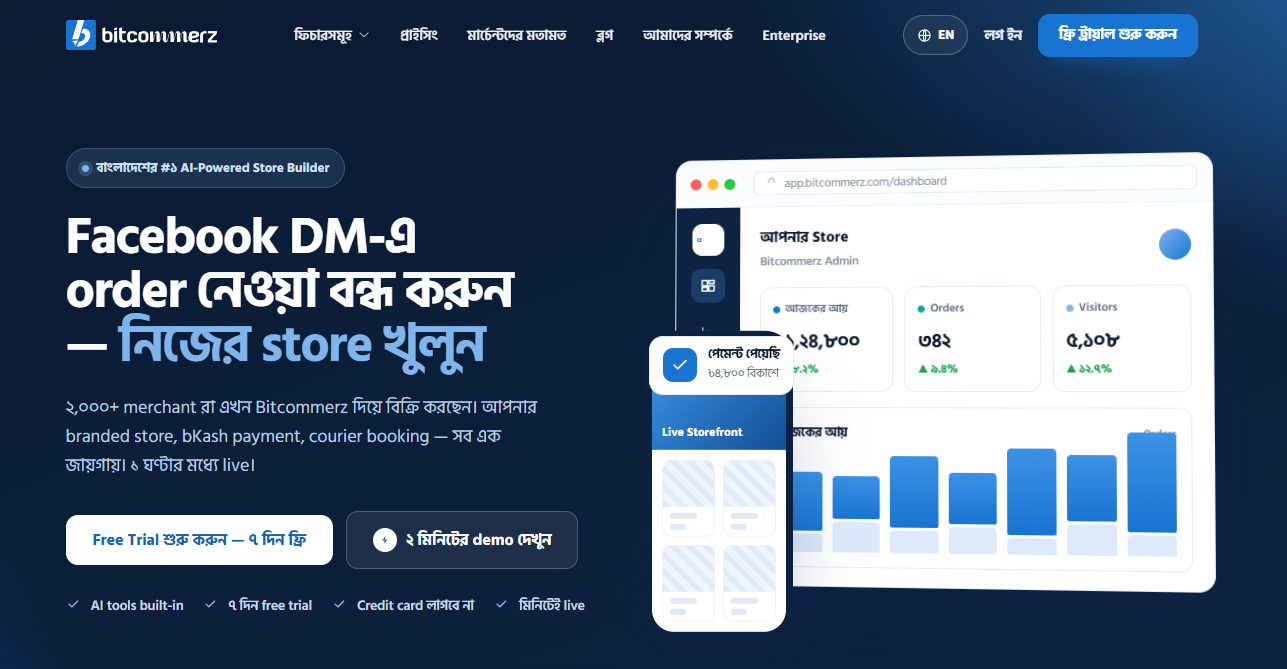
Bitcommerz is our top pick for Bangladesh-focused merchants who want an easy ecommerce website builder with local commerce features.
It combines a no-code website builder with payments, inventory, orders, courier management, analytics, SEO and AI tools.
Bitcommerz describes its builder as drag-and-drop, so merchants can create their stores without writing code.
Why Bitcommerz stands out
The biggest advantage is not simply the website builder.
It is the combination of website + payments + courier + inventory + AI + local workflows in one platform.
Bitcommerz currently lists:
Drag-and-drop website builder
Product and inventory management
bKash and Nagad
SSLCommerz, aamarPay, UddoktaPay, EPS, PayStation and Stripe (cards, and Rocket via SSLCommerz/aamarPay)
Cash on delivery
Pathao, Steadfast, RedX and CarryBee
SEO and marketing tools
Automated invoices
POS
Mobile store management
AI product description tools
COD fraud checking
Multi-warehouse inventory
Bulk product import
The platform also displays a fraud score for COD orders in its dashboard.
Best for
Bitcommerz is particularly suitable for:
Facebook sellers moving to their own website
Clothing businesses
Local D2C brands
Small and medium ecommerce businesses
Businesses selling primarily inside Bangladesh
Merchants that depend heavily on COD
Businesses that want local payment and courier workflows
Owners who do not want to manage WordPress or servers
The main advantage
The strongest argument for Bitcommerz is local operational simplicity.
Instead of assembling a store from a website builder, payment plugin, courier integration, inventory system and separate fraud tool, merchants can manage these functions from one ecosystem.
7-day free trial
Bitcommerz currently promotes a 7-day free trial and includes its ecommerce tools within its plans.
If you want to test a Bangladesh-focused ecommerce website builder before committing:
Start a Bitcommerz 7-Day Trial
You can also explore the available store designs before signing up:
Explore Bitcommerz Store Templates
2. Shopify: Powerful Global Giant With Higher Dollar Costs

Shopify is one of the world's most established ecommerce platforms.
Its biggest strength is its global ecosystem.
Shopify provides hosted ecommerce infrastructure, themes, checkout, inventory management, analytics, apps and integrations from one platform.
Its current annual-billing pricing starts at $29 USD/month for Basic, with Grow at $79 and Advanced at $299. Monthly billing is higher.
That makes Shopify powerful, but the cost calculation for a Bangladesh-based merchant requires more than looking at the subscription price.
Shopify's strengths
Easy store setup
Professional themes
Large app ecosystem
Strong checkout
International selling
Inventory management
Multichannel selling
Large developer ecosystem
Strong global brand recognition
Built-in AI features
Shopify also supports selling through social channels and other sales channels, while its current plans include AI-related capabilities.
The Bangladesh-specific limitation
The biggest consideration is local payment infrastructure.
If your preferred payment provider is a third-party provider, Shopify may apply third-party transaction fees depending on your plan and setup. Shopify's documentation explicitly states that third-party payment providers can incur additional transaction fees.
The actual payment options available to you also depend on the providers supported for your market.
Therefore, a Bangladeshi merchant should calculate:
Shopify subscription + payment processing + third-party transaction fees where applicable + apps + currency costs + courier integrations
before comparing Shopify against a local SaaS platform.
Best for
Shopify is a strong choice for:
International brands
Businesses selling in multiple countries
Brands that need Shopify's global ecosystem
Merchants with larger technology budgets
Businesses planning international expansion
Not ideal when
You mainly sell inside Bangladesh and want:
BDT-first billing
Local courier automation
Simple local payment setup
Minimal app dependency
A Bangladesh-focused support ecosystem
In those cases, a local platform may be easier to operate.
3. WooCommerce: Highly Customizable but More Technical
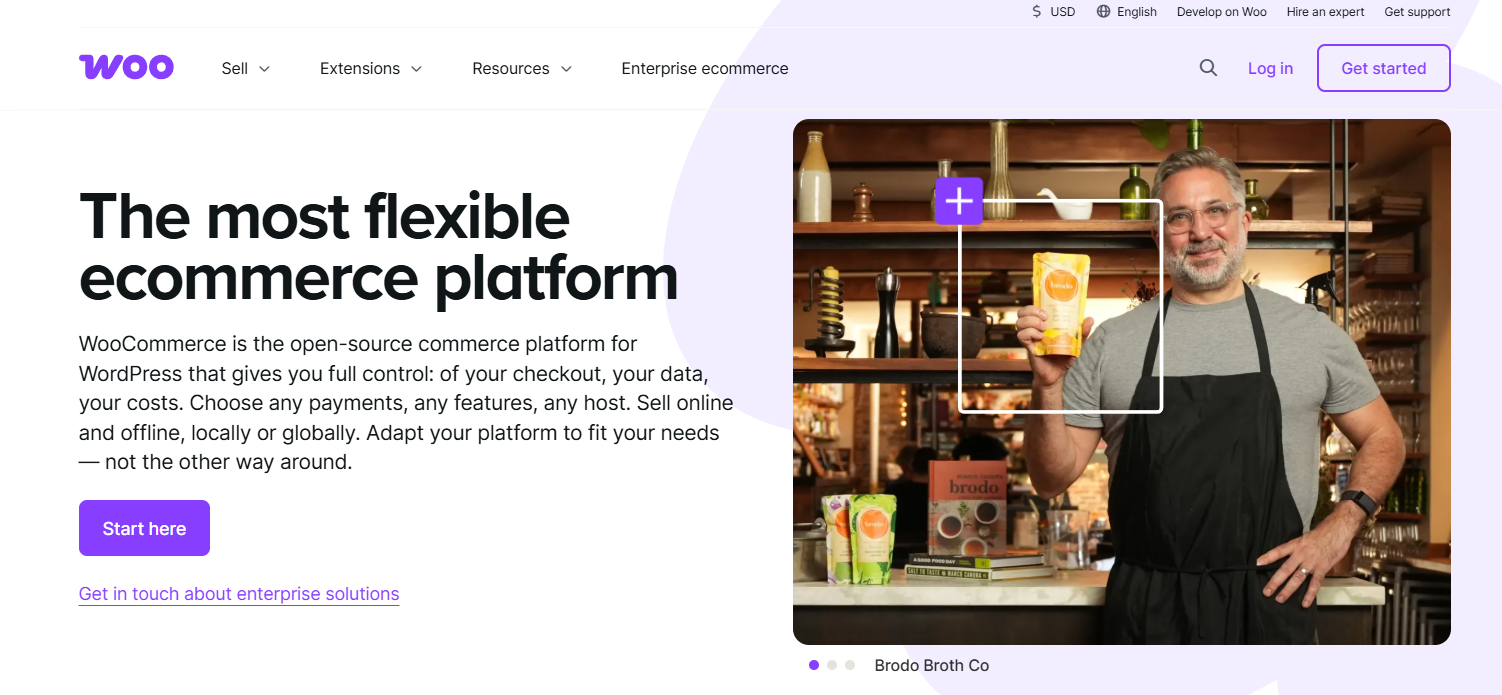
WooCommerce takes a very different approach.
Instead of being a closed hosted ecommerce platform, WooCommerce is an open-source ecommerce platform built for WordPress.
The core WooCommerce software is free. However, your actual store can still have significant costs.
WooCommerce currently says its core platform has no monthly subscription and no revenue share. It estimates hosting for most stores at around $25–$350/month, while extensions can cost roughly $29–$299/year per extension.
That makes WooCommerce flexible but harder to compare using a simple monthly subscription number.
WooCommerce's biggest advantage
Control.
You can customize almost every part of the store.
You can choose:
Hosting
WordPress theme
Payment gateway
Shipping system
SEO tools
Analytics
Plugins
Custom development
Database structure
Checkout functionality
WooCommerce itself explains that payment gateways are generally added through plugins/extensions and that gateway providers have their own account requirements and fees.
The trade-off
That flexibility creates technical responsibility.
You may need to manage:
Hosting
SSL
WordPress updates
Plugin updates
Backups
Security
Performance
Plugin conflicts
Payment integrations
Developer support
For a technically capable business, this can be an advantage.
For a first-time entrepreneur who simply wants to start selling, it can become unnecessary overhead.
Best for
WooCommerce is best for:
Businesses needing deep customization
Content-heavy ecommerce websites
Businesses already using WordPress
Companies with developers or technical agencies
Merchants wanting control over hosting and code
Not ideal when
You want to launch without technical management.
4. ZatiqEasy: A Strong Local Option for Small Businesses
ZatiqEasy focuses on making online selling accessible to smaller businesses.
Its current website promotes a no-code setup where users can create a store, add products and start selling without learning web development.
Zatiq says its platform has surpassed 100,000 stores created and highlights tools for shipping, inventory and order management.
The platform also promotes features such as customer accounts, abandoned-cart functionality and payment options through its ecosystem.
Strengths
Beginner-friendly
Local ecommerce focus
No-code setup
Store creation
Order management
Inventory tools
Payment options
Delivery management
Suitable for social sellers
Best for
ZatiqEasy is worth considering if you:
Are moving from Facebook selling to a website
Want a simple setup
Do not have technical staff
Want a local ecommerce platform
Need basic business management features
The trade-off
The platform is primarily designed around simplicity.
If your business eventually requires highly specialized workflows, extensive customization or a large international ecosystem, you may find platforms such as WooCommerce or Shopify more flexible.
5. WebManza: Local Managed E-Commerce Platform
WebManza is another Bangladesh-focused ecommerce platform.
WebManza describes itself as an all-in-one solution covering website design, ecommerce, inventory management, shipping and logistics.
Its platform includes features such as:
Drag-and-drop website building
Customizable templates
Hosting
Domain support
Inventory management
Order management
Payment integration
Courier integration
Analytics
Automated invoices
Social media integration
Marketing tools
WebManza's FAQ currently lists a standard annual fee of BDT 20,000, although promotional or special offers can differ.
For example, an EBL-specific offer displayed by WebManza shows a discounted annual price of BDT 10,500. That should not be treated as its standard public price.
Best for
WebManza can suit businesses that want:
Local support
A managed ecommerce platform
Website hosting
Payment and courier integrations
Inventory management
Reporting
A simple store management environment
The trade-off
Businesses that need a very large international app ecosystem or extensive developer customization may prefer Shopify or WooCommerce.
Feature & Pricing Comparison Matrix
The following comparison focuses on what matters most to a Bangladesh-based ecommerce business rather than simply counting the number of features.
Feature | Bitcommerz | Shopify | WooCommerce | ZatiqEasy | WebManza |
|---|---|---|---|---|---|
No-code website builder | ✅ | ✅ | ⚠️ WordPress setup | ✅ | ✅ |
Bangladesh-focused | ✅ | ❌ Global | ❌ Global | ✅ | ✅ |
BDT-oriented billing | ✅ | ❌ USD plans | Depends on provider/hosting | Local | BDT |
bKash | ✅ | Gateway dependent | Plugin/gateway | Local options | Gateway integration |
Nagad | ✅ | Gateway dependent | Plugin/gateway | Local options | Gateway integration |
Rocket | Via SSLCommerz/aamarPay | Gateway dependent | Plugin/gateway | Depends on setup | Gateway dependent |
COD | ✅ | ✅ | ✅ | ✅ | ✅ |
REDX integration | ✅ | App/integration | Plugin/integration | Shipping tools | Courier integration |
Pathao integration | ✅ | App/integration | Plugin/integration | Shipping tools | Courier integration |
AI product tools | ✅ | ✅ | Plugin/tool dependent | Platform dependent | Limited compared with dedicated AI stack |
COD fraud scoring | ✅ | Platform/app dependent | Plugin dependent | Platform features vary | Not a core advertised differentiator |
Inventory management | ✅ | ✅ | ✅ | ✅ | ✅ |
POS | ✅ | ✅ | Extensions/POS ecosystem | Business tools | Available ecosystem |
Custom coding | Limited vs open source | Extensive through apps/APIs | ⭐⭐⭐⭐⭐ | More limited | Custom services available |
Hosting management | Included | Included | Merchant responsibility | Included | Included |
Technical burden | Low | Low | High | Low | Low |
Global ecosystem | Medium | ⭐⭐⭐⭐⭐ | ⭐⭐⭐⭐⭐ | Lower | Lower |
Best for | BD-focused SMBs | Global brands | Developers/custom stores | Beginners | Local managed stores |
How to read the table: “Gateway dependent” means the platform may support a payment method through a third-party provider or integration rather than providing the local payment workflow as a core native feature. Always confirm the exact gateway and merchant-account requirements before launch.
Pricing in BDT vs USD
Price is one of the easiest things to compare incorrectly.
A platform charging $29 per month may look inexpensive until you add:
Exchange-rate effects
Payment processing
Third-party transaction fees
Apps
Premium themes
Hosting
Developer costs
Courier integrations
Shopify's current Basic plan starts at $29/month when billed annually, while its monthly price is $39.
WooCommerce has no monthly subscription for its core software, but hosting and extensions create the real operating cost. WooCommerce currently estimates hosting for most stores at $25–$350/month.
This is why comparing only the advertised subscription price can produce the wrong answer.
For a Bangladesh-focused merchant, ask:
How much will my complete store cost to operate for 12 months?
That is the more useful comparison.
bKash and Nagad Integration Complexity
Payment integration is one of the biggest differences between global and local platforms.
With a local ecommerce platform, the merchant expects the platform to understand the payment ecosystem they already use.
With WooCommerce, payment processing is typically added through a payment gateway plugin or extension. WooCommerce itself explains that payment gateway costs can include plugin costs, signup fees, subscriptions and transaction fees depending on the provider.
Shopify similarly relies on supported payment providers for payment processing. Shopify notes that third-party providers can involve additional transaction fees.
Bitcommerz, by contrast, supports bKash, Nagad, SSLCommerz, aamarPay, UddoktaPay, EPS, PayStation, Stripe and COD, with the money going to the merchant's own gateway account.
For a merchant selling primarily in Bangladesh, that difference can simplify the initial setup.
Native Pathao, Steadfast, RedX and CarryBee Courier Booking
Courier management becomes increasingly important as order volume grows.
Imagine receiving 50 orders.
Without automation, your team may need to repeatedly:
Copy customer information.
Open the courier system.
Enter the information.
Create the parcel.
Copy the tracking information.
Update the order.
That is repetitive work and creates opportunities for errors.
Bitcommerz currently offers parcel booking from the order through Pathao, Steadfast, RedX and CarryBee, with customer information carried into the parcel workflow.
Other platforms can support courier workflows through apps, plugins or integrations.
The important distinction is how much setup and manual work is required.
For a Bangladesh-based merchant, this is a more useful question than simply asking whether a platform “supports shipping.”
Built-in AI Tools: Product Writing and Fraud Scoring
AI is becoming part of ecommerce software.
But there is a difference between an AI assistant that helps with general tasks and AI features designed around ecommerce operations.
Bitcommerz currently highlights AI tools for product descriptions and fraud checking, alongside its other ecommerce features.
Its dashboard also displays a fraud score for COD orders.
Shopify also offers built-in AI capabilities on its current plans. Its Basic plan, for example, includes a built-in AI assistant.
WooCommerce takes a more modular approach. Merchants can add functionality through plugins and extensions, which gives them flexibility but can also increase setup and maintenance requirements.
The important question is therefore not:
“Does this platform have AI?”
Ask instead:
“Which ecommerce tasks does the AI actually automate for me?”
Which Is the Best Ecommerce Website Builder for Small Business?For a small business selling primarily in Bangladesh, Bitcommerz is the strongest overall choice in this comparison.
The reason is not simply price.
A small merchant typically needs:
Easy store creation
Local payment methods
COD
Courier management
Inventory
Mobile management
SEO tools
Fraud protection
Minimal technical work
Bitcommerz brings these functions into one platform.
Try Bitcommerz Free for 7 Days
Shopify vs WooCommerce vs Bitcommerz
If you are comparing the three most likely options, the decision becomes easier.
Your priority | Best choice |
|---|---|
Bangladesh-first ecommerce | Bitcommerz |
Local payments and courier workflows | Bitcommerz |
Easy no-code setup | Bitcommerz / Shopify |
Global ecommerce expansion | Shopify |
Maximum customization | WooCommerce |
WordPress content + ecommerce | WooCommerce |
Lowest core software cost | WooCommerce |
Minimal technical management | Bitcommerz / Shopify |
COD-focused Bangladesh store | Bitcommerz |
Large international app ecosystem | Shopify |
Full code and hosting control | WooCommerce |
Final Verdict: Which Platform Should You Choose in 2026?
There is no single best ecommerce website builder for every business.
The right platform depends on where you sell and how you want to operate.
Choose Bitcommerz if:
You primarily sell in Bangladesh and want an easy, local ecommerce platform with BDT-oriented billing, local payments, courier workflows, inventory, AI tools and COD-focused features.
Choose Shopify if:
You want a mature global ecosystem and plan to sell internationally. You are also comfortable with USD-based subscription pricing and potentially adding third-party apps or payment integrations.
Choose WooCommerce if:
You want maximum control over your website and have the technical resources to manage WordPress, hosting, plugins, security and integrations.
Choose ZatiqEasy if:
You are a small merchant or social seller looking for a simple local platform to move your business online without learning web development.
Choose WebManza if:
You want a Bangladesh-focused managed ecommerce solution covering website creation, hosting, inventory, payment, courier and reporting.
Our Overall Ranking
1. Bitcommerz — Best overall for Bangladesh-focused ecommerce
2. Shopify — Best for global growth
3. WooCommerce — Best for customization
4. ZatiqEasy — Best for simple local selling
5. WebManza — Best for a managed local ecommerce setup
The key lesson is simple:
The best ecommerce website builder is not necessarily the platform with the most features. It is the platform that removes the most friction from the way your business actually sells.
For a Bangladesh-first business, local payments, courier automation, COD management and easy store administration can matter more than having thousands of international apps.
If those are your priorities, Bitcommerz is worth testing before you commit to a more complicated setup.
Start Your 7-Day Bitcommerz Trial
Browse Ecommerce Store Templates
Frequently Asked Questions
What is the best ecommerce website builder in Bangladesh?
For a business selling mainly in Bangladesh, Bitcommerz is a strong overall option because it combines a no-code store builder with local payment methods, courier integrations, inventory management and AI-powered ecommerce tools.
Which ecommerce website builder is easiest to use?
Bitcommerz, Shopify and ZatiqEasy are among the easiest options for beginners because they reduce the need for coding and server management.
Is Shopify good for Bangladesh?
Yes. Shopify is a powerful ecommerce platform for Bangladesh-based businesses, especially those planning international expansion. However, merchants should check payment-provider availability, USD subscription costs and third-party transaction fees before choosing it.
Is WooCommerce cheaper than Shopify?
Not necessarily.
WooCommerce's core software is free, but a complete WooCommerce store can require hosting, premium plugins, payment extensions, development and maintenance. Shopify has a predictable subscription model but can also incur app and payment-related costs.
Which platform is best for a small online business in Bangladesh?
Bitcommerz is a strong choice for a small Bangladesh-focused business that wants a simple store, local payments, COD, courier automation and inventory management without hiring a developer.
Can I accept bKash and Nagad through an ecommerce website?
Yes, but the setup depends on the ecommerce platform and payment provider. Bitcommerz currently lists bKash, Nagad and other payment options directly among its supported payment methods.
Which ecommerce platform is best for international selling?
Shopify is generally the stronger option if international selling, global apps and multi-market expansion are your main priorities.
Do I need coding knowledge to build an ecommerce website?
No. Modern hosted ecommerce platforms such as Bitcommerz, Shopify and ZatiqEasy provide no-code or low-code store creation. WooCommerce can also be used without coding for basic stores, but advanced customization often requires technical knowledge.
What should I check before choosing an ecommerce website builder?
Check these 10 things before signing up:
Monthly or annual platform cost
BDT or foreign-currency billing
Payment gateway availability
bKash/Nagad support
COD management
Courier integration
Inventory management
SEO functionality
Mobile management
Migration and support options
A platform that looks cheap at signup can become expensive after adding plugins, apps, payment fees and development.