

Starting an online clothing business in Bangladesh can be a practical way to turn a fashion idea into a business. You can begin by reselling wholesale clothes, creating your own clothing brand, or manufacturing designs for a specific customer group. You do not need a physical showroom to get started, but you do need the right products, reliable suppliers, clear pricing, and a simple way for customers to order.
The opportunity is worth exploring. According to the Bangladesh Bureau of Statistics (BBS), clothing, footwear, and sporting goods were the most commonly purchased online product group in its 2024–25 ICT survey. A reported 70.3% of online shoppers purchased from this combined category. However, strong demand also attracts competition, so your success will depend on how well you serve a particular audience.
If you want to start a clothing business online in Bangladesh, this guide explains how to choose your niche, source wholesale clothing, calculate startup costs, build a branded fashion store, reduce sizing-related returns, and market your products in 2026.
Quick answer: To start an online clothing business in Bangladesh, choose a specific fashion niche, research customer demand, source a small collection from reliable wholesalers or manufacturers, calculate your full costs, create a mobile-friendly online store, set up local payment and courier options, and test your products before investing heavily in inventory.
Key Takeaways
Start with one clothing niche instead of selling every type of fashion product.
Explore wholesale sourcing in Islampur, Keraniganj, and Narayanganj based on the products you want to sell.
Test fabric, stitching, measurements, and supplier reliability before buying large quantities.
Include packaging, marketing, delivery, payment fees, and expected returns when setting prices.
Use clear size charts, real product photos, and accurate color descriptions to reduce customer complaints.
Make your store mobile-friendly because customers may discover products through Facebook, Instagram, and short-form videos.
Offer familiar payment options, including cash on delivery where suitable, but confirm suspicious or high-risk orders before dispatch.
Use a branded ecommerce website to organize product variants, orders, stock, payments, and delivery in one place.
Why Apparel Dominates 50%+ of Bangladesh's E-Commerce Market
Clothing is one of the strongest categories in Bangladesh's online shopping market. However, it is important to distinguish between the share of shoppers buying clothing and the share of total ecommerce revenue generated by apparel.
The BBS 2024–25 ICT survey found that 70.3% of online shoppers purchased clothing, footwear, or sporting goods. This combined category includes more than clothing alone, so the figure should not be interpreted as clothing's exact share of ecommerce revenue.
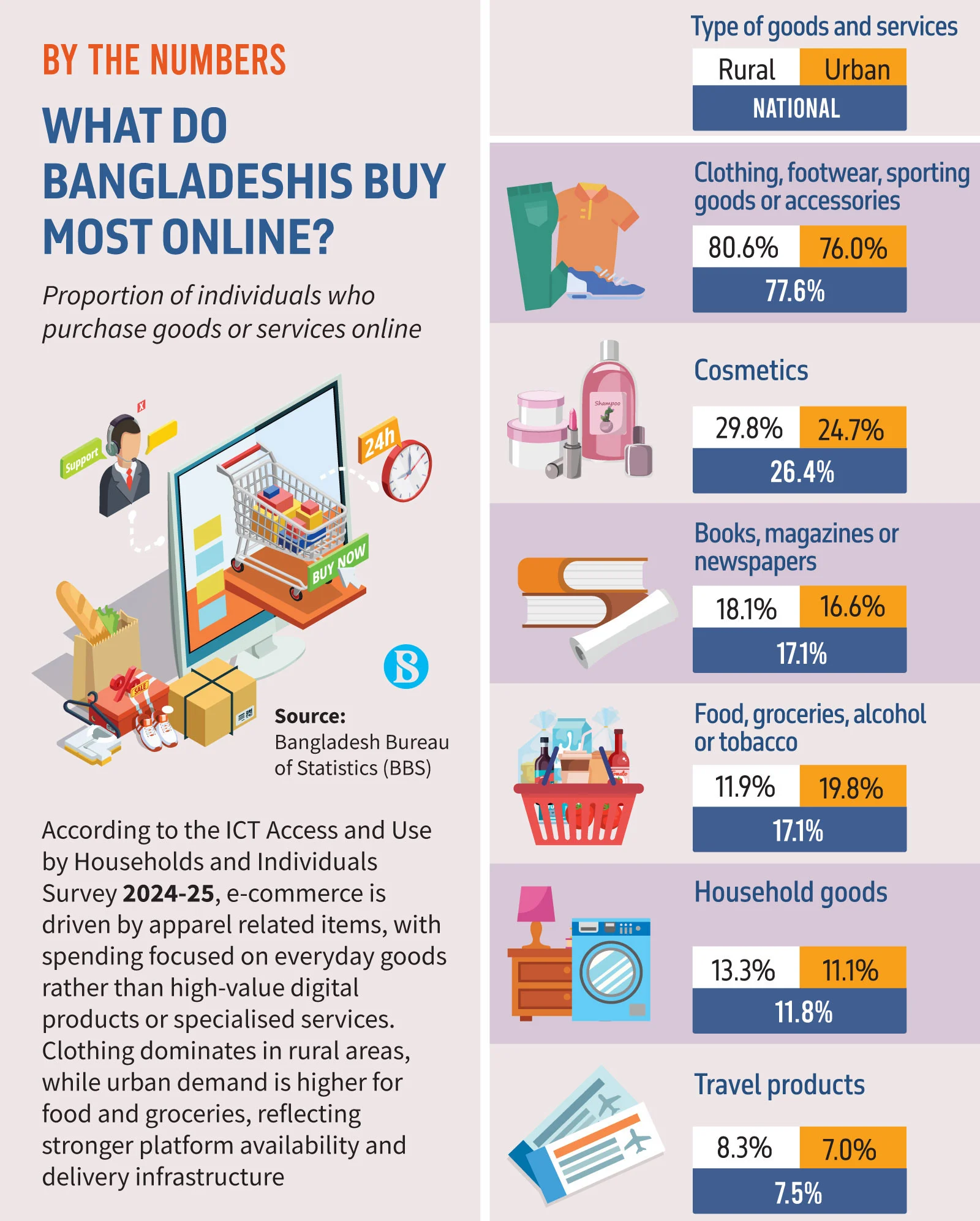
Source: The Business Standerd
Even with that distinction, the data shows why fashion deserves serious attention from new online sellers.
Why customers buy clothes online
Convenience: Customers can browse products and place orders without visiting a physical shop.
Product variety: Online stores can display more colors, sizes, designs, and collections than a small showroom may be able to stock.
Visual discovery: Customers can discover outfits through product photos, styling videos, creator content, and social media posts.
Seasonal demand: Eid, Pohela Boishakh, weddings, winter, and other occasions create opportunities for relevant collections.
Different price ranges: Sellers can serve budget-conscious buyers, premium shoppers, or a particular style preference.
Why the market is competitive
The same advantages that make online fashion attractive also make it crowded. Customers can compare several sellers in minutes, and many stores offer similar designs.
A new seller therefore needs a reason for customers to choose their store.
That reason could be better fabric, consistent sizing, a focused style, original designs, dependable delivery, or more helpful customer service.
Instead of asking, "How can I sell more clothes?" start by asking, "Which customers do I understand, and what can I offer them that other stores do not?"
Finding Your Fashion Niche: Western, Modest Wear, Casuals, and Kidswear
A niche is a specific part of the market you want to serve. Choosing one makes it easier to select products, understand customer needs, create content, and manage inventory.
Here are four practical options for an online clothing business in Bangladesh.
1. Western and Trend-Based Fashion
This category may include tops, dresses, jeans, trousers, shirts, skirts, and seasonal fashion items.
It can suit sellers who understand current styles and can source products regularly.
What to consider: Trends can change quickly. Avoid buying large quantities of a design before testing whether customers want it.
2. Modest Wear and Traditional Clothing
Possible products include hijabs, abayas, modest dresses, salwar kameez, kurtis, sarees, and Panjabis.
This niche allows you to build collections around everyday wear, special occasions, or particular fabric preferences.
What to consider: Fabric quality, transparency, length, sleeve measurements, and accurate product photos can strongly influence customer satisfaction.
3. Casual and Everyday Clothing
Examples include basic T-shirts, polo shirts, shirts, trousers, loungewear, and comfortable everyday outfits.
This category can work well for a brand that focuses on fit, comfort, fabric, and consistent quality.
What to consider: You need a reliable sizing system and enough stock of popular sizes. Too many designs at the beginning can make inventory harder to manage.
4. Kidswear
Products may include baby clothes, children's T-shirts, dresses, school clothing, and occasion wear.
Parents often look for comfort, suitable fabrics, practical designs, and clear measurements.
What to consider: Age alone is not a reliable sizing method. Provide garment measurements and fabric details, and follow appropriate product-safety requirements.
How to choose the right niche
Before selecting a category, research these five things:
Demand: Are people actively searching for these products?
Competition: How many sellers offer similar items?
Sourcing: Can you obtain consistent quality and restock popular designs?
Profitability: Is there enough margin after delivery, packaging, marketing, and returns?
Your advantage: Can you offer better designs, service, quality, or product information?
You can use Google Trends, keyword research tools, marketplace listings, customer reviews, and conversations with potential buyers to validate your choice.
Do not rely only on social media likes. A product that attracts attention may not generate enough profitable orders.
Wholesale Sourcing Guide: Navigating Islampur, Keraniganj, and Narayanganj
Finding the right supplier is one of the most important parts of starting an online clothing business in Bangladesh.
A supplier affects your purchase price, product quality, available sizes, restocking time, and ability to meet customer expectations.
Three useful sourcing areas to investigate are Islampur, Keraniganj, and Narayanganj. They have different strengths, so choose based on the type of clothing you want to sell.
Islampur: Fabric and Wholesale Clothing
Islampur in Old Dhaka is a long-established textile and wholesale trading area. It is worth investigating if you need fabrics, dress materials, or clothing from wholesalers.
It may suit sellers who want to compare several fabric types and suppliers before deciding what to stock.
Before buying:
Compare fabric quality under good lighting.
Check whether the quoted price changes with quantity.
Ask about minimum order quantities.
Confirm whether the same fabric will be available later.
Keep samples or records of the fabric you approve.
You can also investigate online wholesale options where available, but verify the supplier and product quality before committing to a large purchase.
Keraniganj: Ready-Made Garments
Keraniganj is known for its local ready-made garment production and wholesale trade. Reporting by The Business Standard has documented the area's development as an apparel hub, including denim, trousers, shirts, and other locally produced garments.
It can be worth exploring if your business will sell ready-made clothing, especially casual and everyday items.
Before buying:
Inspect stitching, seams, buttons, zips, and finishing.
Compare measurements across sizes.
Check whether the product is locally manufactured or sourced from another supplier.
Ask whether repeat orders will match the original quality.
Confirm exchange terms for defective stock.
Narayanganj: Textile and Knitwear Suppliers
Narayanganj has a long history in textiles and knitwear. Depending on the supplier, it can be relevant for T-shirts, polo shirts, knit tops, and other clothing products.
If you want to develop your own clothing line, ask potential manufacturers about their production capacity, minimum order quantity, sampling process, and lead time.
Not every manufacturer accepts small orders, so confirm the requirements before planning your collection.
A supplier checklist for beginners
Use this checklist when evaluating a wholesale supplier or manufacturer.
I have checked the actual product or a reliable sample.
I have compared prices from multiple suppliers.
I know the minimum order quantity.
I understand the supplier's exchange policy for defective items.
I have checked size consistency and stitching quality.
I know how quickly the supplier can restock.
I have confirmed the payment terms.
I have calculated transport and other sourcing costs.
I have recorded the supplier's contact details and product specifications.
Practical tip: Start with a small test purchase. Sell the products, collect customer feedback, and check the actual profit before placing a larger order.
Manufacturing vs. Ready-Made Wholesale: Pros and Cons for Beginners
There are two common ways to source products for an online clothing business.
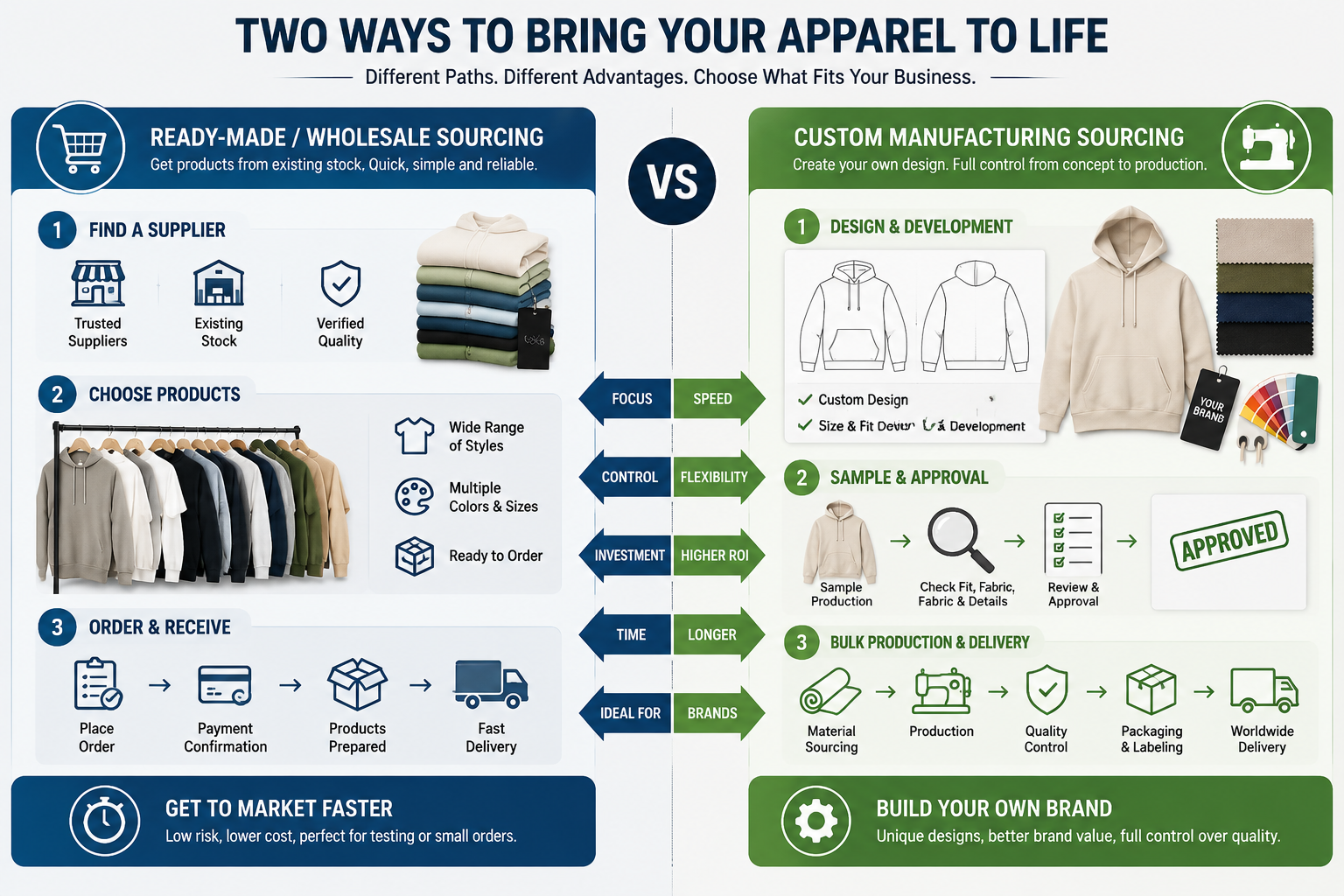
You can buy ready-made garments from wholesalers, or you can work with a manufacturer to produce clothing under your own brand.
Neither option is always better. Your decision should depend on your budget, experience, target customers, and business goals.
Factor | Ready-Made Wholesale | Custom Manufacturing |
|---|---|---|
Initial investment | Often lower | Usually higher |
Launch speed | Usually faster | Requires sampling and production |
Product design | Limited to available designs | More control over design |
Branding | Depends on supplier and product | Greater scope for private labeling |
Minimum quantities | Varies by supplier | Can be higher for custom production |
Quality control | Inspect supplied products | Requires sample approval and production checks |
Main risk | Competing with similar sellers | Unsold inventory and production mistakes |
Best suited for | Beginners and resellers | Brands with validated demand |
Option 1: Start With Ready-Made Wholesale
This approach is suitable if you want to test the market without managing a full production process.
For example, you could source 10–20 carefully selected designs in limited quantities, photograph them, list them online, and see which products attract actual orders.
These quantities are an example of a testing approach, not a universal supplier minimum.
The biggest advantage is speed. You can focus on customer research, product presentation, delivery, and sales before taking on the additional work of manufacturing.
Option 2: Build Your Own Clothing Brand
Custom manufacturing gives you greater control over fabric, fit, color, labels, and design.
For example, you could create a basic T-shirt collection with your preferred fabric weight, fit, and brand label.
However, custom production requires more preparation. You may need to approve samples, confirm measurements, pay for labels and packaging, and inspect the final products.
Before committing, request a written quotation covering:
Fabric and garment specifications
Sample costs
Minimum quantities per style and color
Production time
Printing, embroidery, and labeling
Payment terms
Defect handling
My recommendation: If you are new to fashion ecommerce, begin with a small wholesale collection unless you already have a validated product idea and enough capital for custom production.
How to Calculate Your Clothing Business Startup Cost
There is no single amount required to start an online clothing business in Bangladesh. Your cost depends on the number of products, sourcing method, packaging, marketing plan, and technology you choose.
A small reseller may begin with limited stock, while a brand producing custom garments will need a larger budget.
Instead of relying on a fixed startup figure, build a budget around your own plan.
Main startup expenses
Expense | What to Include |
|---|---|
Initial inventory | Wholesale clothing or manufacturing costs |
Samples | Test garments, fabric samples, and quality checks |
Branding | Logo, labels, packaging design, and brand materials |
Photography | Product photos, models, lighting, or editing |
Online store | Platform subscription, domain, and setup |
Packaging | Bags, boxes, labels, and thank-you cards |
Marketing | Content creation, promotions, and optional advertising |
Delivery | Initial shipping expenses or delivery subsidies |
Returns reserve | Money set aside for failed COD deliveries and exchanges |
Working capital | Money for restocking and regular operating costs |
Example: A small clothing reseller
The following is an illustrative planning budget, not a verified market quotation.
Expense | Example Budget |
|---|---|
Initial clothing stock | ৳15,000 |
Packaging | ৳1,500 |
Product photography | ৳2,000 |
Branding materials | ৳1,000 |
Store and domain allowance | ৳3,000 |
Initial marketing test | ৳3,000 |
Delivery and returns reserve | ৳3,000 |
Total example budget | ৳28,500 |
Your actual costs may be lower or higher. You may already have a phone for photography, use simple packaging, or choose a different ecommerce plan.
Keep enough cash available to restock successful products. Spending your entire budget on inventory can leave you unable to fulfil new orders.
Calculate the real profit on every product
Suppose you buy a garment for ৳350 and sell it for ৳650.
The difference is ৳300, but this is not your final profit.
You still need to account for packaging, payment charges, marketing, delivery subsidies, and expected returns.
Use this formula:
Contribution per completed order = Selling price − Product cost − Packaging − Payment fees − Marketing cost per order − Delivery subsidy − Expected return cost per order
For example, if all additional costs total ৳150, your contribution would be ৳150 before fixed business expenses and taxes.
This calculation helps you compare products fairly and avoid pricing based only on the wholesale cost.
Setting Up Your Branded Fashion Storefront
A Facebook page can help you introduce your clothing brand and reach customers. But a dedicated ecommerce website gives you a more organized place to display products, collect orders, and build your brand.
A good fashion storefront should make it easy for shoppers to answer five questions:
What does the product look like?
What fabric is it made from?
Which size and color should I choose?
How much will I pay, including delivery?
How can I order, pay, or contact the seller?
If customers have to send a message to ask every basic question, they may leave before completing the purchase.
Use Clear Product Photos and Lookbooks
Your product photos should show the actual garment as accurately as possible.
For each product, consider including:
A front view
A back view
Close-ups of fabric and stitching
A photo showing how the garment fits
Available color options
A short video showing the fabric and movement
A lookbook is a collection of photos showing how products look when styled together. It can help customers understand how to wear your clothing and encourage them to explore related products.
Avoid heavy editing that changes the actual fabric color. Accurate images help set expectations and can reduce complaints.
Add a Detailed Size Chart
Do not rely only on S, M, L, and XL labels.
Sizing varies between suppliers and clothing styles.
Your size chart should explain which measurements you use, such as chest, shoulder, sleeve length, waist, hip, and garment length where relevant.
Also explain how customers should measure themselves or compare the measurements with a garment they already own.
Make Color and Size Selection Easy
Each product should clearly display its available sizes and colors.
A customer should not have to guess whether a black T-shirt is available in XL or whether a particular dress comes in a specific color.
BitCommerz offers a drag-and-drop website builder and a collection of ready-made store templates. Its Lifestyle template is designed for fashion and lifestyle stores, making it a useful starting point for a clothing business that wants a branded storefront without building every page from scratch. Product management also supports product variants, which can help organize different sizes and colors.
Explore the BitCommerz store templates to see the available designs.
Prioritize Mobile Shopping
Many customers discover clothing through mobile social media. Your store should therefore work well on smaller screens.
Check that:
Product photos load properly.
Text is readable without zooming.
Size and color options are easy to tap.
Prices and delivery information are visible.
The checkout form is short and clear.
Customers can complete their orders without unnecessary steps.
BitCommerz provides a mobile-friendly storefront builder and checkout features intended to make online ordering easier. Before launch, test the complete buying process on your own phone.
Your goal is simple: help a customer move from discovering a product to placing an order with as little confusion as possible.
Solving the Sizing Return Headache: How to Minimize COD Returns on Clothes
Clothing returns can quickly reduce your profit.
A customer may order a shirt in their usual size, only to discover that the garment fits differently. Another customer may expect a certain fabric or color based on a photo.
When this happens, the seller may face an exchange, a return delivery charge, additional staff work, or a lost sale.
Cash on delivery adds another risk. A customer may refuse the parcel when the courier arrives, even if the order was originally placed correctly.
You cannot eliminate every return, but you can reduce avoidable ones.
1. Use Garment Measurements, Not Just Size Labels
Ask your supplier for the actual measurements of each size.
If you sell your own designs, measure the approved sample and check that production follows the same specifications.
Make it clear whether the chart shows body measurements or garment measurements. These are not the same thing.
2. Show the Fabric Clearly
Include fabric composition where known, thickness, stretch, and care instructions.
If a product is lightweight or has little stretch, say so. Clear descriptions help customers make informed choices.
3. Confirm Size and Color Before Dispatch
For high-value or uncertain orders, confirm the selected size and color before shipping.
This is especially useful when the customer has ordered multiple items or the product has several variants.
4. Make Your Return and Exchange Policy Clear
Explain the time limit, product condition requirements, who pays delivery costs, and how refunds or exchanges are handled.
Follow applicable consumer-protection rules and honor the policy you publish.
5. Use Risk-Based COD Verification
Do not treat every COD order as suspicious. Instead, pay extra attention to orders with repeated failed deliveries, invalid contact details, or other warning signs.
BitCommerz includes AI-based COD fraud scoring, order management, and courier integration features that can help merchants review risky orders and manage fulfilment more systematically.
For a deeper explanation, read How to Prevent Fake COD Orders and Reduce Courier Return Losses.
6. Track Why Returns Happen
Record whether a return resulted from sizing, product quality, incorrect item selection, delivery problems, or customer refusal.
Review this data monthly.
If one product has unusually high returns, investigate the product description, measurements, supplier quality, and marketing content before increasing stock.
Marketing Your Clothing Brand: Facebook, Instagram, and Reels
A good product needs a reliable way to reach the right customers.
For a new online clothing business in Bangladesh, Facebook, Instagram, and short-form video can be useful channels. Their value depends on your target audience, content quality, budget, and ability to turn interest into orders.
Facebook: Build Trust and Reach Customers
Use your Facebook page to publish product photos, new collections, customer questions, styling tips, and delivery updates.
Respond to messages promptly and keep prices, sizes, and ordering instructions clear.
You can also use Facebook and Instagram catalog advertising, where available, to show products to people who may be interested in them.
Before spending heavily on ads, test a small campaign and measure completed orders rather than likes or clicks alone.
Instagram: Present Your Brand Visually
Instagram can be useful for fashion brands that depend on product styling and visual presentation.
Ideas include:
Outfit combinations
New collection previews
Fabric close-ups
Styling tips
Customer photos shared with permission
Behind-the-scenes content
Keep the visual identity consistent so customers can recognize your brand.
Reels and Short-Form Videos
Short videos can demonstrate details that static photos cannot.
For example, show how a garment fits, how the fabric moves, what comes with the product, or how the same item looks in different colors.
Use honest demonstrations rather than misleading filters or exaggerated claims.
Build Your Own Audience and Website
Social platforms are useful for discovery, but your business should not depend entirely on messages and social profiles.
A branded website lets customers browse a structured product catalog and place orders directly. It also gives you a place to publish helpful content and build organic search visibility.
For example, a modest-fashion store could publish guides on choosing hijab fabrics, measuring for an abaya, or caring for embroidered clothing. These pages may attract people searching for information before buying.
BitCommerz includes SEO tools, analytics integrations, and marketing features that can support this approach. Results still depend on your content quality, competition, technical setup, and ongoing work.
Fashion Store Cost Breakdown and Launch Timeline
You do not need to complete everything in one day. A staged launch helps you test the market before spending too much.
The following is a practical example of a four-week launch plan. Your timeline may vary depending on supplier availability and how much preparation you have already completed.
Week | Main Task | Expected Outcome |
|---|---|---|
Week 1 | Choose a niche, research competitors, and contact suppliers | Clear product plan |
Week 2 | Buy samples or initial stock, check quality, and calculate prices | Products ready for listing |
Week 3 | Photograph products, prepare descriptions, and set up the online store | Store ready for testing |
Week 4 | Test checkout, arrange courier and payment options, and launch marketing | First launch and customer feedback |
Week 1: Research Before You Buy
Identify your target customer and compare competing stores.
Check their products, pricing, photography, size charts, delivery terms, and reviews. Look for gaps you can fill rather than copying their entire catalog.
Week 2: Validate Your Products
Inspect samples, confirm measurements, and calculate your costs.
Start with a limited collection. Avoid ordering too many styles or sizes before you know what customers prefer.
Week 3: Build the Store
Add your product photos, descriptions, size charts, color options, contact details, payment information, and return policy.
If you want to avoid a fully custom website build, explore the BitCommerz Lifestyle template and adapt the design to your brand.
Week 4: Test and Launch
Place a test order from a mobile phone. Check the product selection, checkout, confirmation message, payment process, and courier workflow.
Then launch with a manageable marketing budget. Track which products generate orders and which ones receive attention without converting.
When you are ready to create your store, you can sign up for BitCommerz and explore its free-trial option.
Common Mistakes to Avoid When Starting a Clothing Business
Buying Too Much Stock
Large orders can tie up your money in products that do not sell. Test a smaller range first and restock based on actual demand.
Choosing Products Only Because They Are Trending
A popular design may attract attention but face heavy competition or disappear quickly. Check whether you can source it consistently and sell it at a sustainable margin.
Using Supplier Photos Without Checking the Product
The delivered garment may differ in color, fabric, or finishing. Inspect samples and use accurate images whenever possible.
Ignoring Delivery and Return Costs
A high markup does not guarantee a profitable order. Include delivery subsidies, packaging, marketing, payment charges, and expected returns in your pricing.
Depending Only on Facebook Messages
Manual messages can become difficult to manage as order volume grows. A structured online store helps customers select products and gives you a clearer way to manage orders.
Skipping Customer Research
Do not assume you know what customers want. Ask questions, study reviews, test designs, and use sales data to improve your collection.
Frequently Asked Questions
How can I start an online clothing business in Bangladesh?
Choose a niche, research demand, source products from reliable wholesalers or manufacturers, calculate your costs, prepare product photos and size charts, and create an online store. Set up payment and courier options before launching, then test your products with a manageable budget.
How much money do I need to start an online clothing business in Bangladesh?
There is no fixed amount. Your budget depends on inventory, sourcing, packaging, photography, website costs, marketing, delivery, and returns. A small reseller can begin with limited stock, while custom manufacturing generally requires more preparation and capital. Prepare a budget before purchasing products.
Where can I buy wholesale clothes in Bangladesh?
Islampur in Old Dhaka is known for textile and wholesale trading. Keraniganj is associated with ready-made garments and local production, while Narayanganj has a long-standing textile and knitwear industry. Compare suppliers, inspect products, and confirm minimum quantities before placing an order.
Should I manufacture clothes or buy wholesale products?
Wholesale is often a simpler starting point because it lets you test customer demand without managing production. Manufacturing offers more control over design and branding but requires sample approval, production planning, quality checks, and potentially larger investment.
How do I choose the right clothing niche?
Compare customer demand, competition, supplier reliability, expected margins, and your ability to serve the audience. Start with a focused category such as casual wear, modest fashion, Western fashion, or kidswear instead of trying to sell everything.
How can I reduce COD returns for clothing orders?
Provide accurate product photos and measurements, confirm sizes and colors, display a clear exchange policy, and verify suspicious orders before dispatch. Track return reasons so you can identify whether the main problem is sizing, product quality, delivery, or customer behavior.
Do I need a website to sell clothes online in Bangladesh?
You can begin selling through social media, but a branded website provides a structured catalog, product variants, and a direct ordering experience. It can also support search visibility and give customers a consistent place to learn about your products and policies.
What should a fashion ecommerce website include?
At minimum, include clear product photos, descriptions, size charts, color and size options, prices, delivery details, contact information, payment options, and a return policy. A mobile-friendly checkout is essential for customers shopping from their phones.
Can I build a fashion store without coding?
Yes. Ecommerce website builders offer templates and visual editing tools that let you create a store without developing every page from scratch. BitCommerz offers ready-made templates, including its Lifestyle design for fashion and lifestyle stores.
Start Your Online Clothing Business With a Store Built for Fashion
A successful clothing business needs more than attractive products. It needs reliable sourcing, clear product information, realistic pricing, good customer service, and a way to manage orders as sales grow.
Start with a niche you understand. Test a small collection. Listen to customer feedback. Improve your sizing information and product presentation. Then increase your investment when your sales data supports it.
You do not need to build every part of your ecommerce store from scratch.
BitCommerz offers a drag-and-drop website builder, ready-made templates, product variant management, order and inventory tools, payment options, courier integrations, and marketing features to help you manage your online business.
Ready to launch your fashion store?
Build your store around the products your customers want, make ordering simple, and grow your clothing business one well-managed order at a time.